
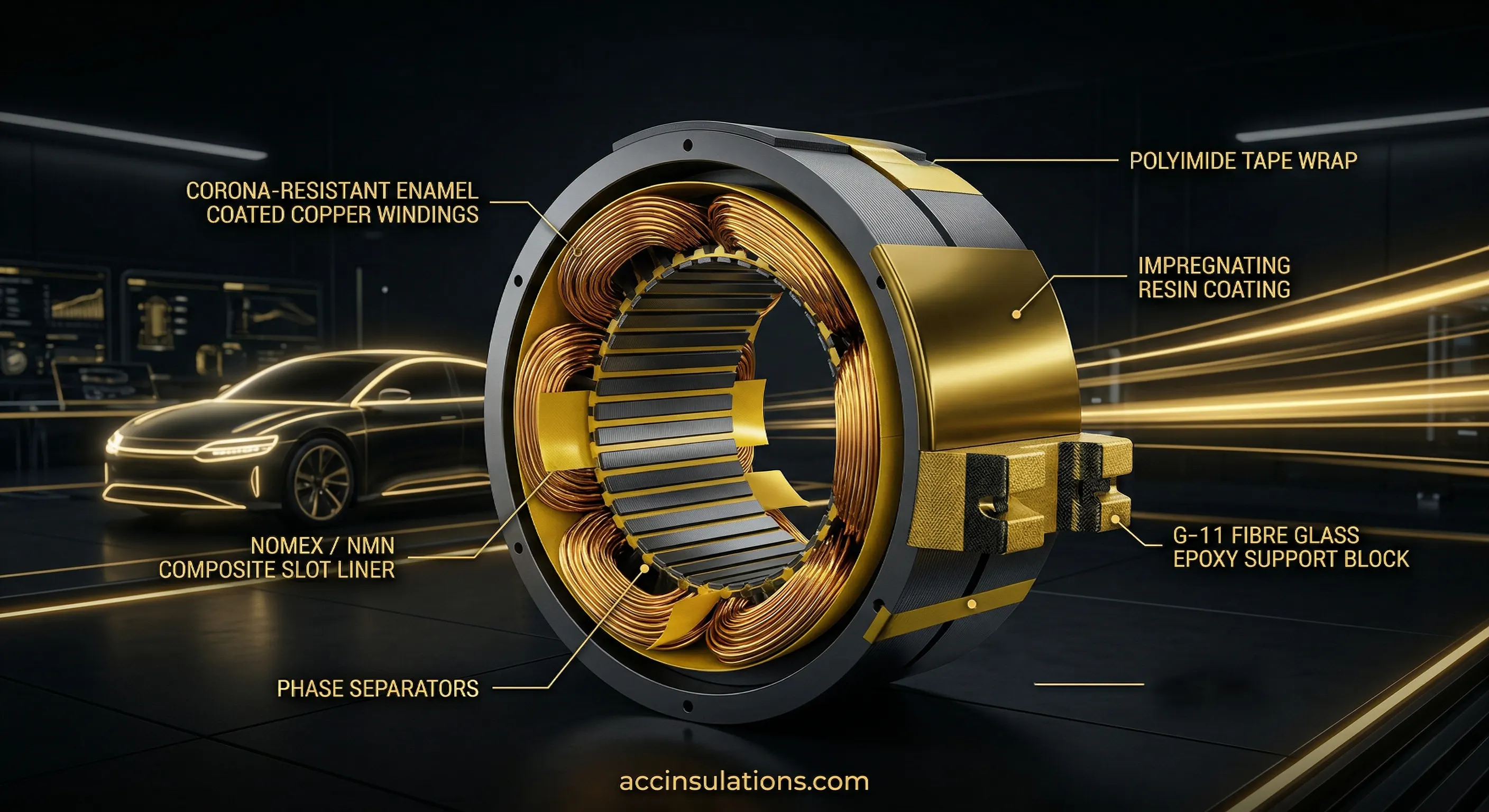
Transitioning from ICE to Electric Vehicle (EV) powertrains fundamentally changed electrical insulation requirements. Standard 50/60 Hz sine waves are simple to insulate against. EV powertrains operate under Variable Frequency Drives (VFDs), rapid PWM switching, and extreme thermal density — environments that destroy conventional cellulosic materials within months.
At ACC Insulations, three primary failure mechanisms are identified in EV motor longevity: high-frequency transient voltages, intense thermal density hotspots, and mechanical vibration fatigue. Solving all three demands moving beyond legacy materials toward Grade G11 Epoxy Glass Laminates and advanced FRP composites.
1. Inverter-Induced Stress & Partial Discharge (PD) in EV Motors
Modern EV inverters use Pulse Width Modulation (PWM) at switching frequencies between 10 kHz and 20 kHz. High switching frequency generates steep-fronted voltage pulses — characterised by extreme dV/dt rates, sometimes exceeding 10 kV/µs. These pulses distribute unevenly across motor windings, concentrating electrical stress at specific turn-to-turn interfaces.
This concentration triggers Partial Discharge (PD) — microscopic electrical sparks igniting within the insulation system wherever air voids or weak bonding exist. PD attacks insulation through three compounding mechanisms:
Corona Erosion: Sustained PD produces ozone and nitric acid. Both chemically degrade standard organic polymer binders — rapidly.
High CTI Composites: G11 laminates carry inorganic glass reinforcement. Tracking resistance (CTI >600) stops carbon path formation under electrical arcing.
800V Architecture Risk: Doubling voltage shrinks PDIV safety margins. Standard Class A materials fail — often catastrophically.
Dielectric Buffer: G11 epoxy glass maintains >20 kV/mm dielectric strength. Provides structural buffer for next-gen 800V EV stators.
"With 800V architectures becoming standard for ultra-fast charging, PDIV margins shrink critically. G11 composites deliver the dielectric buffer and structural rigidity next-gen EV stators demand."
Key metric: Partial Discharge Inception Voltage (PDIV) must remain well above peak operating voltage. For an 800V system with PWM transients reaching 1,600V peak, PDIV of insulation materials must exceed 2,000V minimum — with acceptable safety margin.
2. Skin Effect, Thermal Power Density & Hotspot Management
High-frequency operation triggers the Skin Effect — current concentrates on conductor surfaces rather than flowing through full cross-sections. At 10–20 kHz switching, effective conductor resistance increases significantly, generating localised thermal hotspots invisible to bulk temperature sensors.
Unlike stationary grid transformers with generous oil-cooling reserves, EV motors demand extreme compactness. Power density reaches 5–10 kW/kg in performance EVs. Poor thermal conductivity in insulation materials allows hotspots to accumulate, degrading resin binders and initiating mechanical delamination.
Custom FRP sheets from ACC Insulations maintain full mechanical rigidity at Thermal Class H (180°C) and Class N (200°C) — surviving peak torque transients and rapid acceleration thermal spikes without softening, delaminating, or losing dielectric integrity.
- Slot Liner Insulation: G11 slot wedges withstand continuous hotspot temperatures exceeding 155°C — routine in high-performance EV stators.
- Phase Insulation Barriers: Custom FRP barriers prevent inter-phase flashover under PWM-induced voltage surges.
- Wedge & Retainer Systems: Machined composite wedges lock windings in slot geometry, preventing conductor migration from vibration fatigue.
3. Mechanical Integrity in High-RPM, High-Vibration Environments
Unlike stationary transformers, EV motors face constant road shock, torsional vibration, and centrifugal forces — especially severe in high-RPM permanent magnet rotors exceeding 15,000 RPM. Standard flexible insulation films, used alone, cannot maintain winding geometry under these combined stresses.
Precision-machined epoxy spacers and end-cap rings from hard G11 stock provide rigid winding support. Combined with flexible aramid-based inter-layer films, this creates a hybrid insulation architecture that absorbs vibration energy while maintaining dimensional stability across the motor's service life.
- Rotor Bandage Sleeves: Filament-wound glass fiber sleeves contain permanent magnet assemblies against centrifugal separation.
- Bearing Isolators: Non-conductive FRP isolators prevent bearing current damage — a common failure mode in inverter-driven EV motors.
- CNC Precision: Dimensional accuracy within ±0.05mm ensures consistent air gap geometry critical for motor efficiency.
4. Material Comparison: Traditional Cellulose vs. ACC G11 Composites
| Property | Traditional Cellulose | ACC G11 Epoxy Composite |
|---|---|---|
| Thermal Class | Class A/B — 105–130°C | Class H/N — 180–200°C |
| Dielectric Strength | Moderate (oil-dependent) | >20 kV/mm dry |
| Moisture Absorption | Hygroscopic — 6–10% | Non-hygroscopic — <0.1% |
| Tensile Strength | Low — deforms under load | 300+ MPa — structural grade |
| Tracking Resistance (CTI) | Poor under PD attack | CTI >600 — arc resistant |
| PWM Switching Compatibility | Fails under dV/dt stress | Engineered for inverter-fed duty |
| Machinability (CNC) | Frays — no precision possible | ±0.05mm achievable |
5. Automotive Standards & Supply Chain Compliance
EV insulation components entering Tier 1 automotive supply chains face non-negotiable quality requirements. ACC Insulations manufactures machined composite components designed to integrate into IATF 16949-aligned supply chains.
- IEC 60034-18: Functional evaluation of turn-to-turn insulation for rotating electrical machines — required baseline for EV motor slot liners.
- IEC 60112: CTI (Comparative Tracking Index) certification — mandatory for materials operating above 630V.
- UL 94 V-0: Flame retardancy rating — demanded by EV battery-pack adjacency requirements.
- IEC 60085: Thermal class certification from Class F through Class N — traceable material documentation provided.
Each batch carries traceable test documentation — critical for automotive PPAP (Production Part Approval Process) submissions and Tier 1 supplier qualification audits.
EV Material Selection Tool
Calculate PDIV safety margins for 400V vs. 800V architectures. Verify thermal class compliance and dielectric limits using ACC's engineering suite.
FAQ — EV Motor Insulation
Conclusion: Composites Drive EV Reliability
EV industry demand for higher voltages, smaller motor footprints, and faster switching frequencies renders conventional cellulosic insulation obsolete. High-precision Fiber Glass Epoxy Laminates (G11) and FRP composite profiles now serve as primary defence against the combined electrical, thermal, and mechanical hazards of modern EV powertrains.
Specifying correct insulation at design stage prevents catastrophic field failures, warranty claims, and supply chain crises. ACC Insulations provides engineered composite solutions — from slot liner films to CNC-machined busbar supports — built specifically for EV and e-mobility applications.
Specify EV Insulation Components
ACC Insulations manufactures G11 slot wedges, FRP phase barriers, filament-wound rotor sleeves, and CNC-machined composite spacers for EV and e-mobility motor manufacturers. Custom dimensions, flame ratings, and thermal class certifications available.
Request Technical Datasheet