
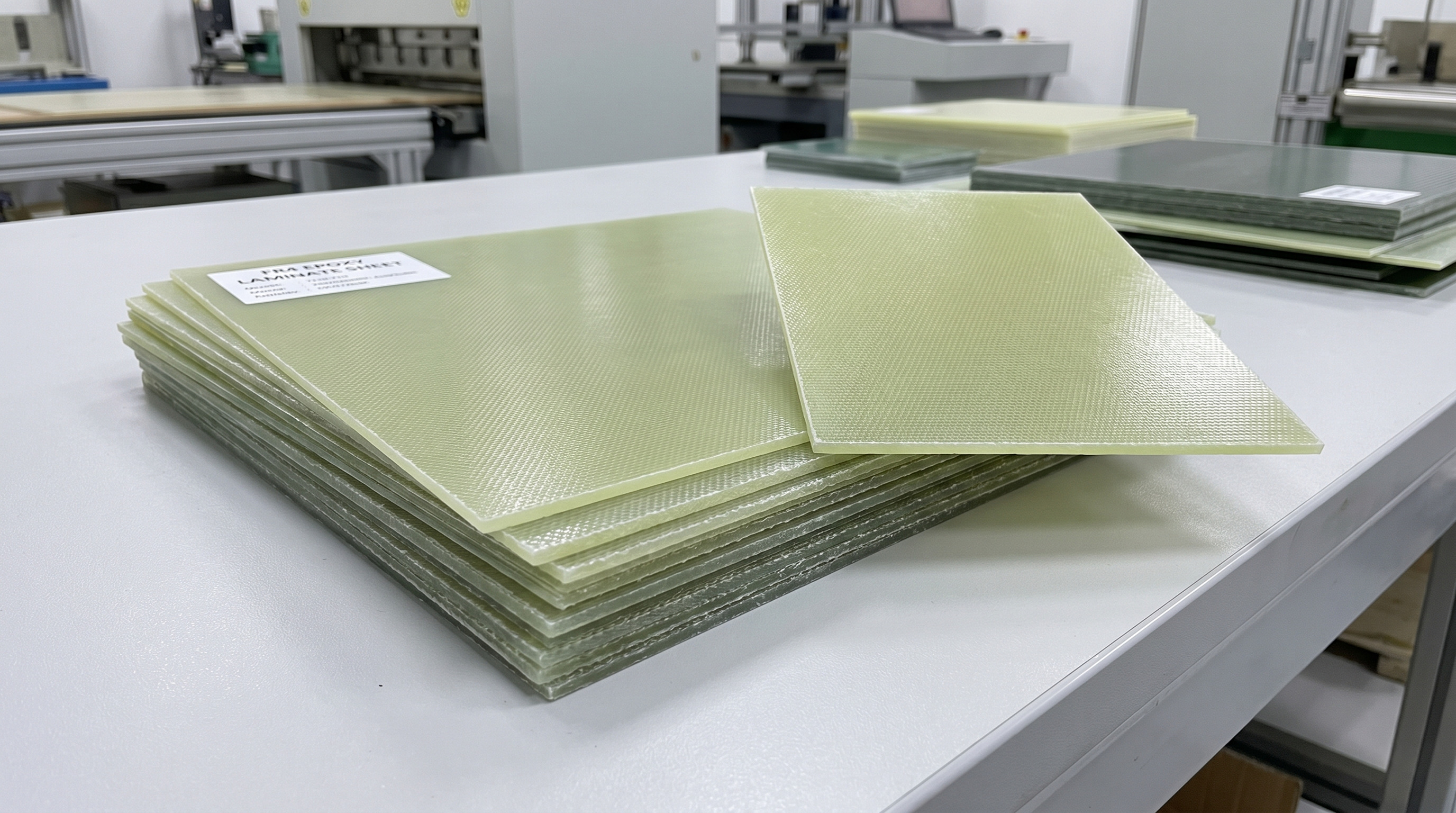
Fibre Glass Epoxy Laminates — Nashik, Maharashtra, India
FR4 Epoxy Laminate Sheet
FR4 epoxy laminate — designated EPGC 202 under IEC 60893 — is a rigid, void-free electrical insulation sheet manufactured by impregnating woven alkali-free glass cloth with brominated epoxy resin and consolidating under industrial heat and pressure. The bromine-modified resin system is what separates FR4 from all other glass epoxy grades: it gives the laminate its UL94 V-0 self-extinguishing behaviour — the sheet stops burning within seconds after an ignition source is removed, a property that is mandatory for indoor switchgear, control panels, and any fire-rated electrical enclosure.
ACC Insulations manufactures FR4 epoxy laminate sheets in our Nashik facility from 0.5 mm to 100 mm thickness, and CNC-machines them into custom components — arc barriers, busbar spacers, phase separators, insulation rings, and slot wedges — per OEM drawings. Every batch is dielectric-tested and ships with full material certification.

Technical Specifications
| FR4 Epoxy Laminate (EPGC 202) — Full Technical Data Sheet | |
|---|---|
| Grade Designation (IEC) | EPGC 202 — per IEC 60893-3-2 |
| Grade Designation (NEMA) | FR4 — per NEMA LI-1 |
| MIL Specification | MIL-I-24768/27 |
| Reinforcement | Woven alkali-free electrical grade glass cloth — 7628 weave style |
| Resin System | Brominated epoxy resin (flame retardant modifier — responsible for UL94 V-0 certification) |
| Sheet Thickness | 0.5 mm to 100 mm (standard); custom on request |
| Standard Sheet Sizes | 1020 × 1220 mm | 1220 × 2440 mm | Custom cut available |
| Flame Rating | UL94 V-0 — self-extinguishing; NEMA test method 7.11 Class I |
| Dielectric Strength | 16–20 kV/mm tested in transformer oil per IEC 60243 |
| Dielectric Constant (Dk) | 4.2–4.8 @ 1 MHz |
| Dissipation Factor (Df) | 0.020–0.035 @ 1 MHz |
| Flexural Strength | 400–550 MPa (grade and orientation dependent) |
| Tensile Strength | 280–340 MPa |
| Compressive Strength | ≥ 350 MPa |
| Glass Transition Temp (Tg) | 130°C |
| Thermal Class | Class F — 155°C continuous |
| Water Absorption | <0.1% after 24h immersion |
| Volume Resistivity | >109 MΩ·cm |
| Surface Resistivity | >109 MΩ |
| Arc Resistance | ≥ 60 seconds (ASTM D495) |
| Density | 1.80–2.00 g/cm³ |
| Colour | Natural green / yellow — Black, Red, White on request |
| Halogen Content | Contains bromine (FR additive) — not halogen-free; specify G10 (EPGC 201) for halogen-free requirement |
| Standards | IEC 60893, NEMA LI-1, UL94, MIL-I-24768/27, IS 2036, IEC 60243 |
What Is FR4 — and What Does EPGC 202 Mean?
FR4 is the NEMA LI-1 designation for a woven glass cloth laminate impregnated with brominated epoxy resin. The "FR" prefix stands for flame retardant — the defining characteristic that separates FR4 from every other epoxy glass laminate grade. EPGC 202 is the exact same material described under the IEC 60893 standard: EP = epoxy resin, GC = glass cloth, 202 = the property class number assigned to the flame-retardant grade.
The laminate is manufactured by precision-impregnating woven alkali-free glass cloth with the brominated epoxy resin system, stacking multiple plies to the target thickness, and consolidating under industrial hydraulic pressure and heat. The result is a void-free, non-hygroscopic thermoset sheet with a stable layered structure that does not delaminate under thermal cycling, mechanical load, or long-term oil immersion.
The Bromine Flame Retardant System — How UL94 V-0 Is Achieved
The core engineering difference in FR4 is its brominated epoxy resin. Bromine atoms are chemically bonded into the resin backbone during synthesis — they are not a surface coating or additive that can leach or wear away. When the laminate is exposed to a flame source, the bromine atoms interrupt the combustion chain reaction at the free-radical level: they scavenge the reactive hydrogen and hydroxyl radicals that propagate burning, effectively starving the flame of its chemical fuel supply.
The practical result is a material that self-extinguishes within 10 seconds after the ignition source is removed, producing a char residue at the burn site rather than propagating a flame front. This behaviour is precisely what UL94 V-0 measures and certifies — the most stringent standard vertical flame rating in the UL94 system, and the minimum requirement for electrical insulation inside switchgear, control panels, and enclosed electrical equipment in most international specifications and building codes.
Key Electrical & Mechanical Properties
Thickness Range & Available Forms
ACC Insulations supplies FR4 epoxy laminate across the full thickness spectrum — from thin sheet for PCB and panel barrier applications through to heavy-section boards for structural switchgear insulation and machined components.
Thin Sheet
PCB substrates, slot liners, inter-layer barriers, panel board insulation. Die-cut or CNC-routed to shape.
Medium Board
Phase separators, arc chute barriers, busbar spacers, structural panel insulation. Most common specification range.
Heavy Section
Machined components — standoffs, blocks, support pillars, transformer-end insulation rings. CNC-turned or milled per drawings.
FR4 vs G10 vs G11 — Grade Selection Guide
FR4, G10, and G11 are three grades within the same fibre glass epoxy laminate family. Each is the correct choice for a different set of requirements. Selecting the wrong grade leads either to over-specification and unnecessary cost, or to under-specification and in-service failure. The table below maps the critical selection criteria to the right grade:
| Property / Requirement | FR4 (EPGC 202) | G10 (EPGC 201) | G11 (EPGC 203) |
|---|---|---|---|
| Flame Retardancy — UL94 V-0 | ✔ Yes — mandatory grade | ✘ No — not rated | ✔ Yes |
| Dielectric Strength (oil) | 16–20 kV/mm | 16–20 kV/mm | 16–20 kV/mm |
| Flexural Strength | 400–550 MPa | 400–550 MPa | 400–550 MPa (retains 50%+ at 150°C) |
| Glass Transition Temp (Tg) | 130°C | 130°C | 175°C |
| Max Continuous Temp (Class) | Class F — 155°C | Class F — 155°C | Class H — 180°C |
| Halogen-Free | ✘ Contains bromine | ✔ Yes — halogen-free | ✘ Contains bromine |
| Hot Mechanical Strength (>130°C) | Drops significantly above Tg | Drops significantly above Tg | Retains 50%+ at 150°C |
| Dissipation Factor (Df @ 1 MHz) | 0.020–0.035 | 0.020–0.035 | 0.0025 (lowest loss) |
| Cryogenic Use | Limited | Preferred | Limited |
| Machinability | Excellent — standard tooling | Excellent — standard tooling | Harder — carbide tooling required |
| PCB Substrate Standard Grade | ✔ Industry standard | Not preferred | Overkill for standard PCB |
| Switchgear / Panel (fire-rated) | ✔ Required | ✘ Non-compliant | ✔ Acceptable |
| IEC / NEMA Reference | EPGC 202 / FR4 | EPGC 201 / G10 | EPGC 203 / G11 |
Manufacturing Process — How FR4 Sheet Gets Made
Every FR4 sheet manufactured at ACC Insulations goes through a controlled multi-stage process designed to deliver consistent density, void-free structure, and uniform dielectric properties across the entire sheet area — not just at the edges where most incoming inspection is done.
Glass Cloth Selection — Alkali-Free, Electrical Grade
Woven alkali-free glass cloth (E-glass, 7628 weave style) is selected for zero alkaline content — alkaline impurities cause moisture-induced dielectric degradation over time. The 7628 weave provides the balanced warp/fill mechanical strength that gives FR4 its uniform flexural and tensile properties in both directions.
Brominated Epoxy Resin Impregnation
The glass cloth is precision-dip-coated with brominated epoxy resin using a controlled treater line. Resin content, pickup weight, and drying parameters are set to achieve the target resin-to-glass ratio — critical for meeting both dielectric strength and mechanical property specifications simultaneously.
B-Stage Prepreg — Partial Cure to Stable State
The impregnated cloth (now called "prepreg") passes through a heated treater oven that partially cures the resin to B-stage — solid, non-tacky, and stable at room temperature, but with reactive sites remaining for final cure. B-stage prepreg is then cut to sheet size.
Multi-Ply Lay-Up & Hydraulic Press Consolidation
Multiple prepreg plies are stacked to reach the target sheet thickness, placed between polished steel cauls, loaded into multi-opening hydraulic presses, and consolidated at high temperature and pressure for a controlled dwell time. This eliminates all air pockets, flows the resin uniformly, and achieves complete crosslinking into the final thermoset structure.
Post-Cure & Dimensional Conditioning
Pressed sheets undergo a controlled post-cure thermal cycle to complete crosslink density and maximise Tg achievement. Sheets are then conditioned to ambient temperature under controlled conditions to prevent warping and ensure dimensional flatness within tolerance.
In-House Quality Testing — Per-Batch Certification
Every production batch is tested for dielectric breakdown voltage (IEC 60243), flexural strength, water absorption, and dimensional conformance before release. Batch test certificates with actual measured values are issued with every shipment — not just a declaration of conformity.
CNC Machining into Custom Components (Optional)
Certified FR4 sheet is CNC-routed, drilled, milled, or turned into custom fibre glass epoxy components — arc barriers, phase separators, standoffs, spacer rings, slot wedges, busbar supports — per customer engineering drawings and dimensional tolerances.
Applications of FR4 Epoxy Laminate
FR4 is the industry-standard insulation laminate for flame-rated electrical applications across power generation, distribution, and industrial sectors:
Why FR4 Is Mandatory for Switchgear & Control Panels
The question asked by every procurement engineer sourcing insulation sheet for panel fabrication is: can I use G10 instead of FR4 to save cost? The answer is unambiguous — and the consequences of getting it wrong are serious.
IEC 62271 (high-voltage switchgear), IEC 61439 (low-voltage switchgear and controlgear assemblies), and virtually all utility and industrial switchgear specifications require insulation materials to be self-extinguishing — a property defined by the material's behaviour under a standardised vertical flame test. G10 (EPGC 201) has no flame retardant certification and will sustain combustion after an ignition source is removed. FR4 (EPGC 202) self-extinguishes within 10 seconds — earning its UL94 V-0 rating.
In practice, an arc fault, a loose connection, or a phase-to-ground fault inside a panel can produce enough localised heat to ignite insulation material. In a panel built with FR4, the fire self-extinguishes and the damage is contained. In a panel built with G10, the fire propagates — with the potential to destroy the entire panel, the switchroom, and adjoining structures. This is not a theoretical risk; it is the reason the standards exist, and the reason certified switchgear manufacturers specify FR4 without exception.
Why Choose ACC Insulations for FR4 Sheet
Direct Manufacturer — Nashik
Manufactured in our own facility with full process control — no intermediary margin, no imported sheet repackaged. You buy from the manufacturer at manufacturer pricing.
Batch Test Certificates
Dielectric strength, flexural strength, and water absorption results from your specific production batch ship with every order. Not a general conformity declaration — actual measured values.
Full CNC Machining Capability
FR4 sheet CNC-routed, drilled, and milled into custom components per your engineering drawings. Prototype and production volumes accepted. No outsourcing — in-house machines.
0.5 mm to 100 mm — Any Size
Thinnest sheet for PCB barriers to heaviest section for structural components — all manufactured to spec and cut to your exact dimensions. No minimum sheet size surcharge on standard stock.
IEC 60893 & UL94 V-0 Compliant
EPGC 202 grade, IEC 60893 standard, UL94 V-0 rating — every sheet. Compliance documentation available for your QA records and customer approvals.
Pan-India Dispatch
Maharashtra-based manufacturing with established logistics to switchgear OEMs, transformer manufacturers, and panel builders across Maharashtra, Gujarat, Tamil Nadu, Telangana, and Delhi NCR.
Engineering Tools Suite
Calculate dielectric clearance margins, required sheet thickness for your voltage class, and weight per panel for FR4 — using our interactive insulation engineering tools designed for switchgear and transformer design engineers.
Frequently Asked Questions
FR4 is the NEMA LI-1 designation for a woven alkali-free glass cloth laminate impregnated with brominated epoxy resin. The "FR" stands for flame retardant — FR4 is self-extinguishing and rated UL94 V-0. EPGC 202 is the equivalent IEC 60893 designation: EP = epoxy resin, GC = glass cloth, 202 = the specific property class number assigned to the flame-retardant grade. Both designations refer to exactly the same material and are used interchangeably in technical specifications and purchase orders across India and globally.
FR4 (EPGC 202) and G10 (EPGC 201) are built on identical glass cloth and epoxy resin construction and share the same mechanical and dielectric properties — 400–550 MPa flexural strength, 16–20 kV/mm dielectric strength, and Tg 130°C. The critical difference is the resin system: FR4 uses a brominated epoxy resin that makes the laminate self-extinguishing with UL94 V-0 certification. G10 uses a halogen-free epoxy resin with no flame retardant certification. FR4 can always substitute G10 — same performance, plus fire safety compliance. G10 cannot substitute FR4 wherever UL94 V-0 is mandated by the specification or standard.
ACC Insulations manufactures FR4 epoxy laminate sheets from 0.5 mm to 100 mm thickness. Standard sheet sizes are 1020 × 1220 mm and 1220 × 2440 mm. Custom thicknesses, non-standard sheet sizes, and CNC-machined components — spacers, rods, tubes, slot wedges, arc barriers, standoffs — are all manufactured to customer engineering drawings. Contact our technical sales team with your thickness, sheet dimensions, and application requirements for pricing and lead time.
FR4 (EPGC 202) has a dielectric strength of 16–20 kV/mm when tested in transformer oil per IEC 60243. This is the standard design figure used for switchgear and HV insulation clearance calculations. Volume resistivity is greater than 10⁹ MΩ·cm, and water absorption remains below 0.1% after 24-hour immersion — ensuring the dielectric performance is stable even in humid environments and during long-term service.
IEC 62271 (HV switchgear), IEC 61439 (LV switchgear assemblies), and most utility and industrial panel specifications require insulation materials to be self-extinguishing — meaning they stop burning within seconds after the ignition source is removed. FR4 (EPGC 202) earns UL94 V-0 certification by meeting this requirement. G10 (EPGC 201) has no flame retardant certification and will sustain combustion. In an arc fault event inside a panel, FR4 self-extinguishes and contains the damage. G10 propagates a fire. This is the engineering and legal reason FR4 is the mandatory grade for certified switchgear and panel fabrication — not a preference.
Yes. FR4 machines cleanly with standard carbide tooling — CNC routing, drilling, milling, and sawing all produce smooth, delamination-free edges when done with appropriate cutting parameters. ACC Insulations offers full in-house CNC machining of FR4 into custom components including arc chute barriers, busbar spacers, phase separators, insulation rings, standoffs, slot wedges, and complex structural insulation parts. Provide your engineering drawing and dimensional tolerances and we will quote fabricated components directly.
FR4 epoxy laminate from ACC Insulations complies with IEC 60893 (EPGC 202 designation), NEMA LI-1 (FR4 designation), UL94 V-0 flame retardancy rating, MIL-I-24768/27 (US military specification), and IS 2036 (Indian Standard for industrial laminates). Dielectric strength testing follows IEC 60243. Batch test certificates covering actual measured dielectric strength, flexural strength, and water absorption results are provided with every shipment.
FR4 (EPGC 202) has a glass transition temperature (Tg) of 130°C and is rated Thermal Class F at 155°C continuous. Mechanical properties — particularly flexural strength — begin to reduce significantly above the Tg of 130°C. For applications with sustained operating temperatures above 130°C, G11 (EPGC 203) with Tg 175°C and Class H rating (180°C) is the appropriate upgrade — it retains over 50% of its room-temperature flexural strength at 150°C, where FR4 cannot.
Request a Quote
Pricing & datasheet within 24 hours