
1 What Is Transformer Winding Insulation?
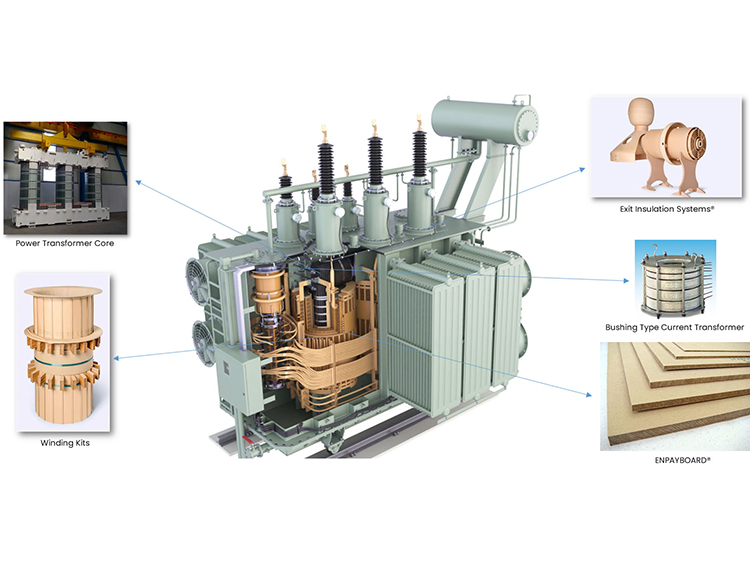
Transformer winding insulation is a multi-layered dielectric system applied around, between, and throughout the copper or aluminium conductors in both primary and secondary windings. Its role is threefold: to provide electrical isolation between turns and layers at high voltage, to act as a thermal conduit between the hot conductor and the cooling medium (typically transformer oil), and to provide mechanical structure that keeps windings rigid under electromagnetic forces.
The insulation system typically consists of several distinct layers and components working together:
- Turn insulation: Thin paper or film tape wrapped tightly around each individual conductor — the first and most critical barrier against inter-turn short circuits.
- Layer insulation: Sheets of Kraft paper or composite laminate separating concentric winding layers and managing layer-to-layer voltage gradients.
- Duct spacers and cylinders: Pressboard structures that create controlled oil-flow channels, enabling efficient heat removal from the copper interior.
- End insulation: Pressboard caps, rings, and angle rings at winding ends to manage the elevated voltage stress at conductor terminations.
- Barrier insulation: Large cylinders or barriers between the primary (HV) and secondary (LV) windings, providing the main high-voltage isolation gap.
An insulation system is only as strong as its weakest point. Even a single air void, moisture-saturated spot, or mechanical crack in the dielectric structure can initiate partial discharge — a slow but progressive damage mechanism that ultimately leads to total insulation failure and transformer loss.
2 Managing Extreme Electrical Stress & Dielectric Strength
Inside a high-voltage power transformer, thousands — sometimes hundreds of thousands — of volts are applied across windings that are physically close together. The winding insulation system must provide sufficient dielectric strength (measured in kV/mm) to prevent voltage from jumping between:
- Adjacent turns within the same layer (inter-turn insulation)
- Separate winding layers (inter-layer insulation)
- The HV winding and the LV winding (main insulation barrier)
- The winding and the grounded steel core or tank
"A transformer is only as strong as its weakest point of insulation. When insulation degrades, partial discharge begins — localized plasma arcing that steadily erodes the dielectric material, generates carbon deposits, and triggers exponential thermal runaway. The result is irreversible failure."
The standard material for oil-impregnated transformers is electrical-grade Kraft paper, which achieves dielectric strengths of 10–18 kV/mm when properly oil-impregnated under vacuum. The oil-paper combination is vastly superior to either material alone — the oil fills microscopic cellulose pores, eliminating air inclusions that would otherwise act as partial discharge initiation sites.
3 The Thermal Challenge: Insulation Class Ratings Explained
Heat is the primary enemy of transformer insulation longevity. Copper losses (I²R heating) and core eddy current losses raise the winding temperature continuously during operation. Insulation materials must not only survive this heat — they must facilitate heat transfer to the cooling medium.
IEC 60085 defines standard thermal classes for electrical insulation. Selecting the correct class is critical to achieving the transformer's designed service life:
| Thermal Class | Max Temp. | Typical Material | Application |
|---|---|---|---|
| Class A 105°C | 105°C | Standard Kraft Paper (oil-impregnated) | Distribution transformers, conventional oil-immersed units |
| Class B 130°C | 130°C | Thermally Upgraded Kraft Paper | Power transformers requiring extended service life |
| Class F 155°C | 155°C | DMD Composites (Dacron-Mylar-Dacron) | Dry-type transformers, cast resin units |
| Class H 180°C | 180°C | NMN (Nomex-Mylar-Nomex) Laminates | High-temperature dry-type, traction, aerospace |
| Class C >180°C | >180°C | Mica, ceramics, silicone composites | Furnace transformers, extreme industrial environments |
Materials like electrical-grade crepe paper and Thermally Upgraded Kraft Paper are engineered with controlled porosity. This allows transformer oil to fully impregnate the cellulose matrix under vacuum-pressure treatment (VPI), displacing all moisture and air, and creating a thermally conductive, void-free dielectric barrier that efficiently carries heat away from the conductors.
4 Mechanical Rigidity: Surviving Short-Circuit Forces
One of the least-discussed but most catastrophic threats to transformer windings is the mechanical force generated during a short-circuit fault. When external faults occur on the grid, fault currents — often 20 to 30 times the rated current — surge through the windings for fractions of a second. The resulting electromagnetic force follows the square of the current, meaning a 20× current surge generates forces 400 times greater than normal operating loads.
These forces are directional:
- Radial forces (hoop forces) try to burst the outer winding outward and compress the inner winding inward simultaneously.
- Axial forces act like a hydraulic press, compressing the winding vertically with enormous intensity at the winding ends.
Structural insulation — high-density pre-compressed pressboards and densified laminated wood (DLW) — form solid spacers, radial support cylinders, and clamping ring structures that lock the winding geometry in place. Without this mechanical framework, windings deform during the first major fault, create air gaps and irregular oil channels, and fail shortly after. A transformer with correctly specified pressboard insulation can withstand multiple fault events without structural damage.
5 Common Transformer Insulation Failure Modes
Understanding how insulation fails is as important as specifying the right material. The majority of unplanned transformer outages — representing billions in lost revenue annually worldwide — stem from one of these root failure mechanisms:
Thermal Ageing
Sustained operation above the insulation's thermal class rating accelerates cellulose polymerisation breakdown. Insulation becomes brittle, mechanically weak, and electrically vulnerable even without an electrical fault trigger.
Moisture Ingress
Water reduces dielectric strength exponentially. Even 2% moisture content in Kraft paper can reduce its dielectric withstand voltage by more than 50%, dramatically increasing partial discharge risk.
Partial Discharge (PD)
Air voids, oil contamination, or delamination within insulation create localised electric field hotspots. Microscopic plasma discharges erode the material progressively until a full puncture occurs.
Short-Circuit Deformation
Insufficient mechanical support allows winding conductors to shift during fault events. Displaced conductors create non-uniform electrical stress concentrations and inevitable insulation breakdown.
6 Modern Composite Insulation for Dry-Type Transformers
Dry-type (air-cooled or cast resin) transformers cannot rely on oil impregnation to boost dielectric performance. They demand insulation materials with inherently superior thermal and dielectric properties — and significantly higher mechanical toughness to survive without the damping effect of oil.
Modern high-performance solutions include:
DMD — Dacron-Mylar-Dacron Composites
A three-layer flexible laminate combining polyester fibre outer sheets with a biaxially oriented polyester film (Mylar) core. Rated Class F (155°C), DMD provides excellent tear resistance, good conformability around conductors, and strong moisture resistance. Widely used as slot liner and phase insulation in dry-type transformer windings.
NMN — Nomex-Mylar-Nomex Composites
NMN laminates combine aramid paper (Nomex®) outer layers with a Mylar polyester film core. Rated Class H (180°C), NMN offers exceptional thermal stability, inherent flame resistance, and outstanding dielectric properties. The aramid fibres also provide impact toughness — critical in traction and industrial transformer applications exposed to vibration.
Glass Fibre Composites
Glass fibre reinforced laminates — such as G10/FR4 and G11 epoxy-glass — are used for structural insulation components in dry-type units. They provide outstanding compressive strength, dimensional stability across temperature cycles, and excellent resistance to creeping discharge on surfaces, making them ideal for terminal boards, end flanges, and support brackets.
7 Insulation Design Principles: What Engineers Specify
Designing a transformer insulation system is not simply selecting a material — it is engineering a complete dielectric architecture. Experienced transformer designers account for:
- Impulse voltage withstand (BIL): The insulation must survive lightning impulse voltages far above normal operating voltage without puncture.
- Power frequency withstand: Sustained high-voltage AC testing (typically 2× rated voltage + 1000V for one minute) validates insulation integrity before commissioning.
- Partial discharge limits: IEC 60270 defines acceptable PD levels (in pC — picocoulombs) to confirm the absence of voids or contamination in finished transformers.
- Winding temperature rise: Insulation thickness, oil duct positioning, and pressboard spacer design are calculated to ensure maximum winding temperatures stay within the material's thermal class rating at rated load.
- Moisture content control: Finished transformer assemblies are dried in ovens and vacuum-impregnated with oil. Residual moisture must typically be below 0.5% by weight for Class A systems.
Saving money on insulation materials in transformer manufacturing is a false economy. The materials represent less than 5% of total transformer cost, yet insulation quality directly determines whether the transformer will last 15 years or 40 years. A single premature failure on a large power transformer can cost operators $2–20 million in replacement and downtime costs.
Frequently Asked Questions
Turn insulation is the paper or film tape wrapped directly around each individual conductor, preventing adjacent turns within a single layer from shorting to each other. Layer insulation refers to the flat sheets or cylinders placed between complete winding layers, managing the higher cumulative voltage gradient that builds across multiple turns. Both are essential — turn insulation handles low inter-turn voltages precisely, while layer insulation manages progressively higher inter-layer potentials as voltage accumulates across the winding stack.
Kraft paper alone contains microscopic air-filled cellulose pores. Air has a much lower dielectric strength than transformer oil (approximately 3 kV/mm vs. 10–15 kV/mm for good insulating oil). These air pockets are sites where partial discharge initiates at relatively low voltages. Vacuum-pressure impregnation (VPI) replaces all trapped air with transformer oil, creating a void-free composite dielectric whose combined strength is far superior to either material alone. Oil impregnation also significantly improves thermal conductivity, directly contributing to winding heat removal.
Thermal class is a standardised rating (per IEC 60085) that defines the maximum continuous operating temperature at which insulation maintains acceptable properties over its design lifetime. Class A (105°C) applies to standard Kraft paper in oil-immersed transformers. Thermally upgraded paper extends this to Class B (130°C). Dry-type transformers use Class F DMD composites (155°C) or Class H NMN/Nomex-based laminates (180°C). Exceeding the thermal class rating dramatically accelerates insulation ageing — a 10°C increase above the rated temperature roughly halves the insulation's remaining service life (the "10°C rule" of Arrhenius ageing).
Finished transformers undergo a comprehensive suite of factory acceptance tests (FAT) per IEC 60076. These include applied voltage withstand tests, induced over-voltage tests, impulse voltage tests (simulating lightning surges), partial discharge measurement per IEC 60270, and insulation resistance / polarisation index (PI) measurements. Transformer oil is also separately tested for dielectric breakdown voltage, moisture content, and dissolved gas analysis (DGA) to confirm the health of the complete insulation system before the unit leaves the factory.
Engineering Tools Suite
Calculate exact dielectric limits, Class A–H thermal capacities, and optimal winding clearances for your power transformers using our interactive design tools.
Need Custom Transformer Insulation Solutions?
ACC Insulations supplies precision-slit insulating tapes, die-cut pressboard components, vacuum-dried pre-compressed cylinders, and custom-fabricated NMN/DMD composite parts to heavy electrical manufacturers across India and worldwide. All materials conform to IEC 60641, IEC 60763, and IEC 60626 standards.
Speak to an Engineer