
Global renewable capacity surpassed 3,700 GW in 2024. Uptime governs profitability. Wind turbines sit on salt-sprayed coastlines. Solar farms burn under desert sun. Both demand electrical insulation far beyond standard industrial grades—or face premature failure with no easy repair path.
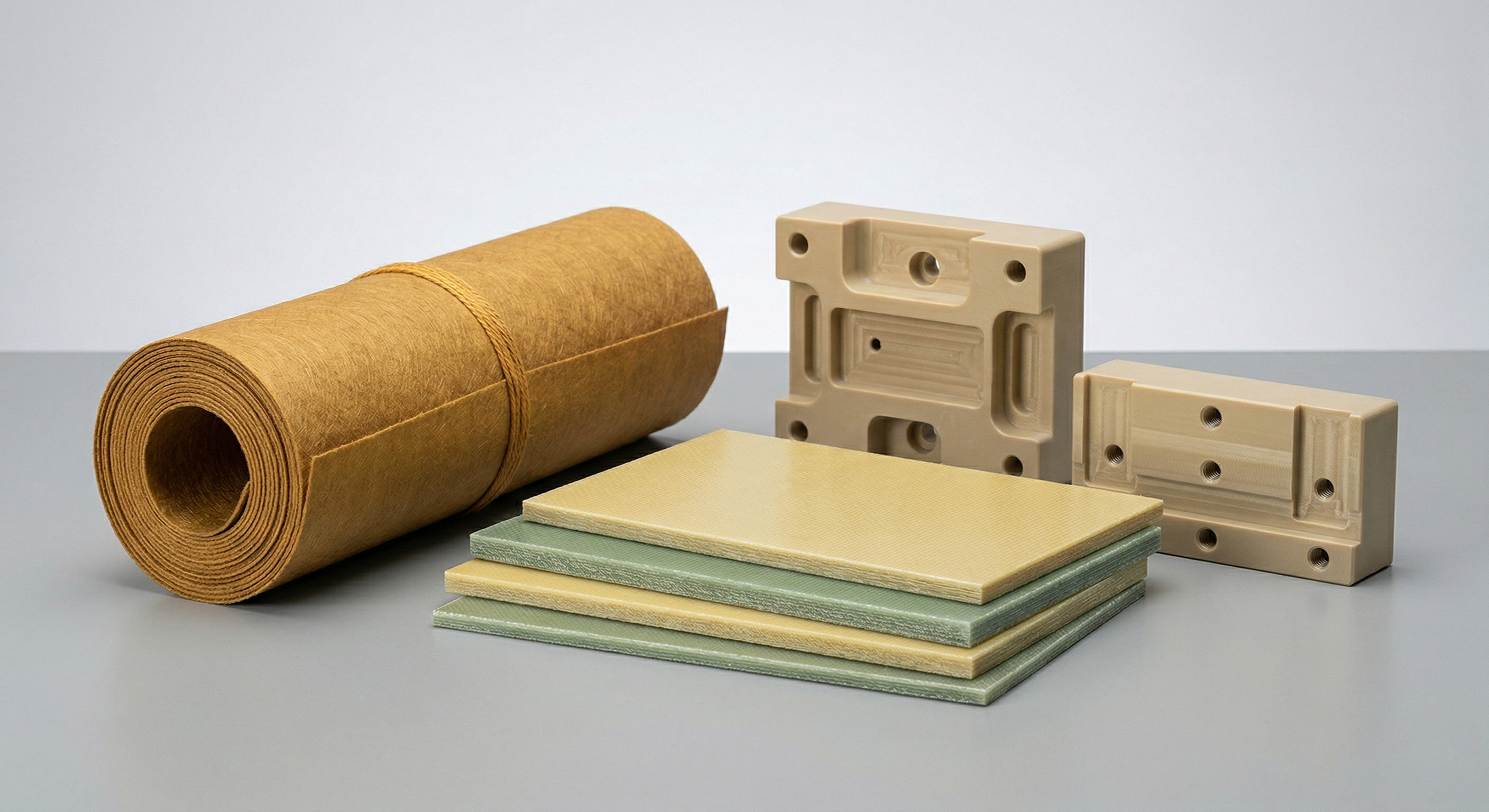
At ACC Insulations, we supply high-performance composite insulation engineered specifically for these stressors. This guide breaks down exact material choices, failure modes, and compliance requirements for renewable engineers and procurement teams.
1. Why Standard Insulation Fails in Renewable Systems
Standard industrial insulation — designed for climate-controlled switchrooms and factory motors — encounters three failure modes unknown in those environments:
- Hygroscopic Absorption: Offshore salt mist penetrates porous materials. Absorbed moisture lowers dielectric strength dramatically, creating conductive tracking paths leading to phase-to-phase short circuits.
- Thermal Cycling Fatigue: Solar sites experience 60°C daily swings. Repeated expansion and contraction delaminates composite structures not engineered for cyclical thermomechanical stress.
- High-Frequency Partial Discharge (PD): IGBT switching at 10–20 kHz generates voltage transients. Standard laminates erode under sustained partial discharge, accelerating insulation aging by 5–10×.
Field Data: Generator insulation failures account for 23% of unplanned wind turbine downtime. Nacelle access alone costs $15,000–$40,000 per incident offshore. Correct material selection eliminates this failure mode entirely.
2. Wind Turbine Generator (WTG) Insulation Requirements
Wind turbine generators operate under constant vibration and asymmetric electromagnetic loading. Generator slot insulation and inter-phase barriers must survive without friction-induced dielectric wear for 25 years in unmaintained nacelles.
2a. Offshore Salt Mist — Primary Threat
Salt mist conductivity: 1,000–5,000 µS/cm. Standard Class F laminates with phenolic resin absorb up to 0.4% moisture by weight — sufficient to degrade surface resistivity below safe thresholds within 18 months at sea.
- Correct Choice: Grade G11 Fiber Glass Epoxy Laminate — near-zero water absorption (<0.1% per IEC 60893), CTI >600 V, flexural strength >450 MPa. Purpose-built for offshore humidity extremes.
- Slot Insulation: G11 sheets machined to slot depth, with glass fiber tube liners preventing winding-to-core shorts under centrifugal force.
- Phase Barriers: G11 or DMD composite — mechanically rigid yet electrically transparent at operating frequencies.
2b. Vibration-Induced Wear
WTG rotor vibrations range 2–40 Hz with amplitudes up to 5 g. Loose slot insulation migrates, fractures at edges, and initiates turn-to-turn shorts. Precision CNC-machined G11 components with tight dimensional tolerances (+0/-0.1 mm) eliminate movement entirely.
"Offshore wind insulation must survive without maintenance for 25 years inside a nacelle 100 metres above the North Sea. Choosing materials by price instead of specification guarantees failure."
2c. Thermal Class for WTG
Direct-drive generators reach 140°C hotspot at full rated load. Doubly-fed induction generators (DFIG) peak at 155°C during grid faults. Minimum specification: Class F (155°C). High-power offshore units demand Class H (180°C) for thermal margin.
3. Solar Inverter Insulation Requirements
Central inverters (500 kW–5 MW) and string inverters both use IGBTs switching at 10–20 kHz. Each switching event generates a fast-rising voltage transient (dv/dt up to 10 kV/µs) that stresses insulation far beyond rated dielectric voltage.
3a. Partial Discharge — Root Failure Cause
PD occurs in micro-voids within insulation exposed to transient overvoltages. Each PD event erodes 0.1–1 µm of material. Sustained IGBT switching creates thousands of PD events per second. Standard FR4 sheets fail within 3–7 years under this regime.
- Busbar Support Insulation: FRP Sheets with CTI >600 V and high arc resistance rating — prevents surface tracking between phases at DC link voltages up to 1,500 V DC.
- Phase Separators: DMD (Dacron-Mylar-Dacron) flexible composite — conforms to tight inverter enclosures, withstands repeated thermal cycling without delamination.
- Transformer Insulation within Inverters: Thermally Upgraded Kraft Paper for oil-cooled isolation transformers co-located with the inverter.
3b. Thermal Cycling Specification
"A desert solar inverter cycles from 10°C pre-dawn to 75°C mid-afternoon. Every day. For 25 years. That equals 9,125 full thermal cycles — each one stressing every bonded interface inside the enclosure."
DMD composites withstand 10,000+ thermal cycles per IEC 60216 without delamination. Coefficient of thermal expansion (CTE) matched to copper busbars prevents interface stress fractures.
4. Material Requirements: Wind vs. Solar
| Requirement | Wind Turbine (WTG) | Solar Inverter |
|---|---|---|
| Thermal Class | Class F (155°C) / H (180°C) | Class B (130°C) to F (155°C) |
| Primary Material | G11 Epoxy Glass Laminate | FRP Sheets / DMD Composite |
| Dielectric Priority | Arc Resistance, Surface Resistivity | CTI >600 V, PD Resistance |
| Moisture Resistance | Critical — non-hygroscopic essential | Moderate — IP65 enclosure assists |
| Mechanical Stress | Vibration, Centrifugal Force | Thermal Expansion/Contraction |
| UV Resistance | Low (enclosed nacelle) | High (outdoor inverter enclosures) |
| Key Standards | IEC 60034, IEC 60893 | IEC 62109, IEC 60664 |
5. High-Altitude Dielectric Breakdown in Solar Farms
Air pressure at 3,000 m altitude drops to ~70 kPa versus sea-level 101 kPa. Paschen's Law dictates a direct reduction in air breakdown voltage. At 4,000 m — common in Rajasthan, Ladakh, and Tibetan solar zones — clearance distances must increase 25–35% over sea-level design values.
- Creepage Distance: Solid insulation materials must provide increased creepage to compensate for reduced air dielectric performance. Precision CNC-machined FRP components maintain exact creepage specifications to ±0.05 mm.
- Partial Discharge Inception: Lower pressure reduces PD inception voltage. Materials with high PD extinction voltage — G11, FRP sheets — maintain safe operation where standard materials would initiate discharge.
- Pollution Level: Desert dust accumulation increases surface conductivity. High CTI materials prevent wet-band arcing on contaminated insulator surfaces.
High-Altitude Rule: Every 1,000 m above sea level, recalculate creepage and clearance per IEC 60664-1 Altitude Correction Factor. Standard sea-level component drawings fail compliance at 2,500 m and above.
6. IEC Compliance & 25-Year Service Life
Renewable developers sign 25-year power purchase agreements (PPAs). Insulation failure mid-PPA period triggers liquidated damages, OEM warranty claims, and grid operator penalties. Material compliance prevents all three.
- IEC 60085: Thermal classification verification for each batch.
- IEC 60893: FRP laminate dielectric strength, flexural strength, and water absorption certification.
- IEC 60034-18: Generator winding insulation qualification for rotating machines.
- IATF 16949: Manufacturing process control ensuring batch-to-batch consistency — critical for multi-turbine projects requiring identical insulation performance across hundreds of units.
ACC Insulations manufactures and fabricates materials spanning the full IEC thermal spectrum — from Class B FRP sheets for solar inverters to Class H G11 laminates for offshore WTG slot insulation — with full traceability documentation for each shipment.
Renewable Insulation Calculator
Calculate altitude correction factors, thermal safety margins, and creepage distances for wind and solar installations using our Engineering Suite.
FAQ: Renewable Energy Insulation
Which laminate grade suits offshore wind generators?
Grade G11 Epoxy Glass Laminate. Near-zero water absorption, CTI >600 V, Class F or H thermal rating. Suitable for both slot insulation and phase barriers in salt-spray environments.
Why do solar inverters cause insulation failure faster?
IGBT switching at 10–20 kHz creates continuous voltage transients. Each transient initiates partial discharge in micro-voids. Standard materials erode at 3–7 years. DMD composites and high-CTI FRP sheets resist PD for 20+ years.
Does altitude affect insulation selection?
Yes. Above 2,000 m, apply IEC 60664-1 altitude correction. Increase creepage and clearance distances 20–35%. Use precision CNC-machined components for tight dimensional compliance.
What thermal class suits WTG generators?
Class F (155°C) minimum for DFIG types. Class H (180°C) for direct-drive high-power offshore generators operating at full rated load without derating.
Source Renewable-Grade Insulation
ACC Insulations supplies IEC-certified G11 laminates, FRP sheets, DMD composites, and CNC-machined components for wind and solar projects. Full traceability documentation included.
Request Technical Data Sheet